
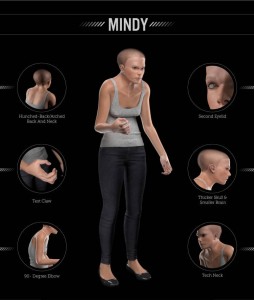
Check out “Mindy,” the grotesque human of the future! She appears to have a few issues, right? You might be wondering where she came from (and why I am sharing her picture). She is the 3D representation of a “future human,” which shows how using technology too much could form some rather unattractive abnormalities.
A company called TollFreeForwarding collaborated with a 3D designer and researched the ways our bodies can change over time from overusing technology (mainly handheld devices). Mindy is supposed to be from the year 3000 (should we survive that long), but how many people do you know who are developing problems from too much tech right now?
Mindy first problems are her hunched back and “tech neck” from looking down at her device all of the time. The human skull typically weighs about twelve pounds, but once it’s at an angle (as it is when looking down at your phone), that weight can feel more like 30-45 pounds on your spine. Over time, your neck becomes strained and the shoulders hunch up.
Mindy also has a really attractive “text claw,” which comes from holding the phone in her hand while texting with her thumb. Keeping her arm at a 90-degree angle with device in hand strains the hand, wrist, and elbow causing “cubital tunnel syndrome” (inflammation of the ulnar nerve which passes through the elbow).
Researchers also think that her brain would be smaller and her skull would be thicker. The small brain comes from not having to think as much or struggle for survival as our ancestors did (brain size has reduced in the last 3,000 years). The thick skull is a result of her body protecting her from the radiation emitted by devices. People who started using such devices as adults have less exposure to radiation and fully formed skulls, but babies and children are at a higher risk and it is thought they might develop a thicker skull in a protective response. (I recently saw a women in a store with a baby no more than four months old with the phone propped up in the stroller.)
Lastly is Mindy’s horrific-looking third eyelid, which is thought to have developed in response to all of the blue light emitted from screens. Blue light causes the body and brain to be alert and think it’s daytime, which stops the production of melatonin and causes many problems with sleep (especially if you’re staring at your screen late at night or in the middle of
the night because you can’t sleep).
The article also pointed out another problem with Mindy that isn’t visible physically, which is her mental state. Tech usage with too much social media has shown to cause depression and anxiety. Staying inside and staring at devices instead of being outside in sunlight can contribute to more sleep problems and more mood issues.
This picture has haunted me over the past few months so I thought that diving right in and writing about it would be better than thinking about it all of the time. The majority of us in the modern world use the same technology that would cause all of these problems, and none of us will be giving it up. You might be thinking, “but that’s SO far into the future, we’re fine.” I’d like to believe that too, but how many times do you see people bent over their phones while waiting in line, at the doctor’s office, or even in their cars. How many kids (and babies, eek) do you see completely sucked in at the store on devices while their parents push them around in carts?
I can’t help but wonder if this is what Steve Jobs would have wanted, a man who celebrated sleek design and simplicity. Would he befriend Mindy with her altered body, or would they just use avatars and communicate electronically so they never see what the other looks like?
I want to add that I am not much better than anyone else. I try to be cognizant of how I hold my device and give myself breaks, I try not to use my phone constantly, and I don’t use it when I go to bed (except for an alarm, which in itself is a little problematic).
This post isn’t meant to preach or tell everyone what to do with their devices, but what causes me pause is Mindy’s appearance and how we can see people already starting to have her problems (from tech neck to text claw to posture issues, and compare and despair on social media). Who wants that? None of us, I’m sure. So let this post give you pause to think about your tech usage or your kids’ because no one wants to look like Mindy, especially if we are all going to have her haircut in the future!
 f darkness. We weren’t outraged at PG&E for taking safety measures to ensure that another massive fire didn’t break out and incinerate us all, but it was highly inconvenient. Here are my pros, cons, and observations from the last few days of what felt literally like being “powerless.”
 d to be cash only (tough because of our plastic currency dependence). Gas pumps won’t work without power, and all of those generators need that other dependent resource (gas) to run. Of course, many would chalk this up to a “first world problem.” Boo-hoo, there was no power for almost three days, and maybe I agree there. But we live lives that rely on electricity and, even with numerous announcements from PG&E, entire communities felt the effects of this shutdown.
 deliberately make at some point, and then stop thinking about, but continue doing, often every day.” And how habits are loops made up of three parts: the cue (or trigger), the response, and the reward. In the case of the phone, it could be me bored while waiting in line somewhere (cue or trigger) so I check my phone (response), and find that I have email I could read (reward). And so it goes. First in situations of boredom, then in times of avoidance (say, when I don’t want to hear my kids complaining), and finally, just because. How many times have you looked at your phone simply because someone else did? Or checked your email or texts, thinking you heard that little ding, but it was just your imagination. (If you can believe it, the term for that is phantom ringing syndrome.)
 “No problem,” but then I seem to think of reasons why I might need it on (my mom for instance, or some excuse I think is “important”). In the end, it’s just silly anxiety running the show and making me think that the world will end in those twenty-four hours simply because I (the all-important legend in my own mind) don’t have my phone on (in reality, I guess, it is the phone running my show). I will post a follow-up when I complete my thirty days of phone withdrawal and let you know how it went!
 much more. Most of the kids were very interested, watching with gleaming eyes. Then we got to the part which the fireman boasted was the most fun – he opened the door to the passenger side of the truck revealing the “Captain’s seat.” He explained that this is a very important seat, and said that all of the cool tools and technology were used in that spot. Then he asked, “would you like to sit in this seat?” Yes!” they all cried excitedly.
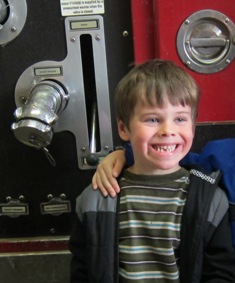 worst part was that the kids knew exactly what to do – get in the seat, turn to the camera, fake smile, picture taken, get down for the next kid. Only one boy out in the whole group insisted on sitting in the seat and asking questions about everything around him, and he was quickly encouraged to “get down so someone else can have a turn!” A turn at what? I thought. The kids will see their pictures and probably like them, and being five years old they probably won’t remember the field trip too much, but how much more valuable would it have been for them and their little working brains to sit in the Captain’s seat and pretend they really were the captain of the fire truck? Something could have sparked inside one of them as they explored and examined all of the new things they saw there. But instead, we take a picture of the moment and we rush them off for next kid’s photo opp.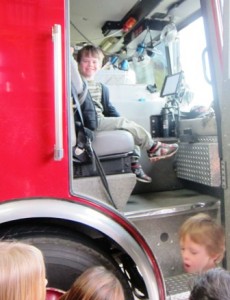
 -line, there is a price to pay for being able to see anyone you know on the Internet – our privacy. Our kids today have been born into a time in which pictures are constantly taken then uploaded for the world to see. In turn, they will do the same, and it’s not always the super cute pictures of them as babies with a sleeping kitten, they’re pictures that can be humiliating or shameful – pictures they wouldn’t want anyone seeing, and now almost anyone can. Wiseman points out, “When you were a teen, your most embarrassing and humiliating moments weren’t up for public discussion and entertainment….She’s living that moment in public. There’s no protection. There’s no privacy. This is her regular, ever-present reality. Your daughter is growing up with a different definition of what’s public and what’s private.”
 l when you were a kid and need that toy (I’m thinking Barbie again or He-Man in my brother’s case). This isn’t new either. But kids who play on-line, get free apps, or just use mom’s phone while in line at the grocery store, see double that, usually for other games (my eight-year-old son thinks he wants every game he sees advertised in other games). According to APA.org, “advertisers spend more than $12 billion per year to reach the youth market and that children view more than 40,000 commercials each year.” Think about all those opportunities for “I gotta have that,” “I need that,” “I’m not good enough or cool enough unless I get that.” It’s overwhelming! Again, if your tween is going to be a “normal” kid (and yes, he or she probably really wants to be) then an on-line world is inevitable – thus, so are the ads.