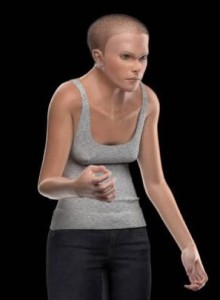
Check out “Mindy,” the grotesque human of the future! She appears to have a few issues, right? You might be wondering where she came from (and why I am sharing her picture). She is the 3D representation of a “future human,” which shows how using technology too much could form some rather unattractive abnormalities.
A company called TollFreeForwarding collaborated with a 3D designer and researched the ways our bodies can change over time from overusing technology (mainly handheld devices). Mindy is supposed to be from the year 3000 (should we survive that long), but how many people do you know who are developing problems from too much tech right now?
Mindy first problems are her hunched back and “tech neck” from looking down at her device all of the time. The human skull typically weighs about twelve pounds, but once it’s at an angle (as it is when looking down at your phone), that weight can feel more like 30-45 pounds on your spine. Over time, your neck becomes strained and the shoulders hunch up.
Mindy also has a really attractive “text claw,” which comes from holding the phone in her hand while texting with her thumb. Keeping her arm at a 90-degree angle with device in hand strains the hand, wrist, and elbow causing “cubital tunnel syndrome” (inflammation of the ulnar nerve which passes through the elbow).
Researchers also think that her brain would be smaller and her skull would be thicker. The small brain comes from not having to think as much or struggle for survival as our ancestors did (brain size has reduced in the last 3,000 years). The thick skull is a result of her body protecting her from the radiation emitted by devices. People who started using such devices as adults have less exposure to radiation and fully formed skulls, but babies and children are at a higher risk and it is thought they might develop a thicker skull in a protective response. (I recently saw a women in a store with a baby no more than four months old with the phone propped up in the stroller.)
Lastly is Mindy’s horrific-looking third eyelid, which is thought to have developed in response to all of the blue light emitted from screens. Blue light causes the body and brain to be alert and think it’s daytime, which stops the production of melatonin and causes many problems with sleep (especially if you’re staring at your screen late at night or in the middle of
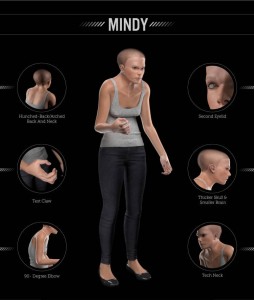
the night because you can’t sleep).
The article also pointed out another problem with Mindy that isn’t visible physically, which is her mental state. Tech usage with too much social media has shown to cause depression and anxiety. Staying inside and staring at devices instead of being outside in sunlight can contribute to more sleep problems and more mood issues.
This picture has haunted me over the past few months so I thought that diving right in and writing about it would be better than thinking about it all of the time. The majority of us in the modern world use the same technology that would cause all of these problems, and none of us will be giving it up. You might be thinking, “but that’s SO far into the future, we’re fine.” I’d like to believe that too, but how many times do you see people bent over their phones while waiting in line, at the doctor’s office, or even in their cars. How many kids (and babies, eek) do you see completely sucked in at the store on devices while their parents push them around in carts?
I can’t help but wonder if this is what Steve Jobs would have wanted, a man who celebrated sleek design and simplicity. Would he befriend Mindy with her altered body, or would they just use avatars and communicate electronically so they never see what the other looks like?
I want to add that I am not much better than anyone else. I try to be cognizant of how I hold my device and give myself breaks, I try not to use my phone constantly, and I don’t use it when I go to bed (except for an alarm, which in itself is a little problematic).
This post isn’t meant to preach or tell everyone what to do with their devices, but what causes me pause is Mindy’s appearance and how we can see people already starting to have her problems (from tech neck to text claw to posture issues, and compare and despair on social media). Who wants that? None of us, I’m sure. So let this post give you pause to think about your tech usage or your kids’ because no one wants to look like Mindy, especially if we are all going to have her haircut in the future!
 (because now he requires an article to sound more important) is pretty dark in almost all aspects, from the actual lack of lighting in the film to the character himself. As someone said, he’s the “emo Batman” with his smudged eye make-up and the lonely, gritty life he leads. A digital production company decided to take the “original” Batman, Adam West, and put him in The Batman’s trailer. They titled it, “The Batman but with the Goofy Batman.” It’s an entertaining watch to see the original Batman in tights with familiar visual sound effects “BAM!” “KAPOW!” etc. in the mean streets of Gotham City. What it made me think about, though, was Batman’s progression from campy entertainment to dark and violent justice. What does this say about what viewers want to see and what filmmakers create? Do we all want the latest version of Batman to be haunted by his past while ruthlessly killing his foes or would we occasionally like to see some ridiculous dancing and ludicrous situations? I vote for men in tights and silly lines, most others (including my brother, a dedicated fan) would vote otherwise. Do a quick search for “Adam West in the Batman” to check it out and see what you think.
 We recently got chicks (baby chickens, that is) as we do almost every year. What is so incredible about a chick is its instinctual ability to survive almost immediately upon hatching. It begins to peck for food, drink water, and seek out the warmth of the heat lamp from the moment we receive them. They don’t technically need a mother hen (though it is nice for them to have one for the protection) because they inherently know what to do from the very start. Humans, and probably most mammals, don’t have a fighting chance, not from birth anyway. We need the care of someone to survive initially. We have instincts too, of course, but as time goes by, we usually explain those away with our thoughts and emotions. A chick’s simplicity – to eat, drink, sleep, poop, repeat from the very start – is admirable.
 As it turns out, the age group that should act the most “adult” – doesn’t. Surprised? Recently, I was listening to a younger podcaster interviewing an even younger food blogger (both considered Instagram “influencers”). They agreed that, when receiving comments/feedback from their posts, TikTok users are the least mean, IG is second, and Facebook and Twitter have the meanest and nastiest commenters. Who typically has accounts to these two outlets? ADULTS. Come on, FB and Twitter adults, grow up and be mature (or maybe that’s not a thing anymore).
 90% of them. The other countries are China, France, U.K, Pakistan, India, Israel, and North Korea (that’s in order of the most to the fewest). The more startling fact is that scientists think it would only take about 100 of these nukes to make life on Earth unsustainable (due to air quality, lack of sunlight to grow food, etc). That’s it, 100! And yet, being the ridiculous Earthlings that we are, we have 12,900 more than necessary. Surprising and yet not surprising, no? Let’s hope they stay un-detonated.
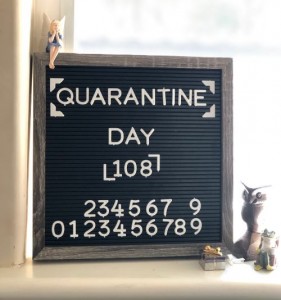 is pic is my daughter’s running total of the start our COVID “adventure,” when things went funny and we all went into hiding. For her that’s when school ended and distance learning began. (She says it won’t be over until we can go to the movies, still not open yet, and not wear masks.) That was 108 days ago. I dashed her plans of having a “quarantine party” on day 100 though; I told her those two words don’t mix well.
 virus shut-down period? I’ve noticed that some moments I’m up, and the next I’m way down. There seems to be no telling when I’m in a “good” mood, “bad” mood, or just feeling in a funk. Usually, my mood is fairly consistent, mostly “even,” but not these days. I noticed that last week when I was doing okay one day, excited about spring and the garden we’re preparing, but the next day I was sad, angry, and feeling hopeless. Yesterday was another one of those days. Why? I wondered. What has changed? Almost nothing, I realized, and that’s part of the problem. Here are a few reasons why you, or other friends or family, might be feeling the same during our self-isolation:
 jobs at the moment. Some may not have jobs to go back to. My good friend is in the final stretch of her education and finishing up her internship. She has not been able to complete it. Her plans of getting a job, moving, and starting her career have been temporarily altered. She wonders if this carefully crafted plan will happen at all. And she’s terribly disappointed.
 A few quotes from the days of reading books to my children when they were small still ring in my head. This one, by Kevin Henkes of Lily’s Purple Plastic Purse, is from Lily’s teacher in a note to her after she had a very bad day and got in trouble. He told her, “Today was a difficult day. Tomorrow will be better.” Yes, it will.
 California anyway). We’re starting week three of shelter in place, only going out for food or necessities, and for my family, homeschooling. These are trying times, indeed. By Friday, school is out and we need that break – from each other. Despite the inconveniences, and hardships for many who aren’t working right now, we can try to find the good, even if we don’t really feel like it (and I can tell you that no one in Target yesterday felt like it, not even a smile could be had). Here they are anyway:
 do most of the time we’ve found). So, even if you don’t own a dog, know that those who do are happier and that’s good (as we know, cats could care less).
 our view for the better. Feeling stuck gets me anxious, frustrated, and clawing at the cage to get out. Feeling safe gives relief and calm. I’m reminding myself of this often.
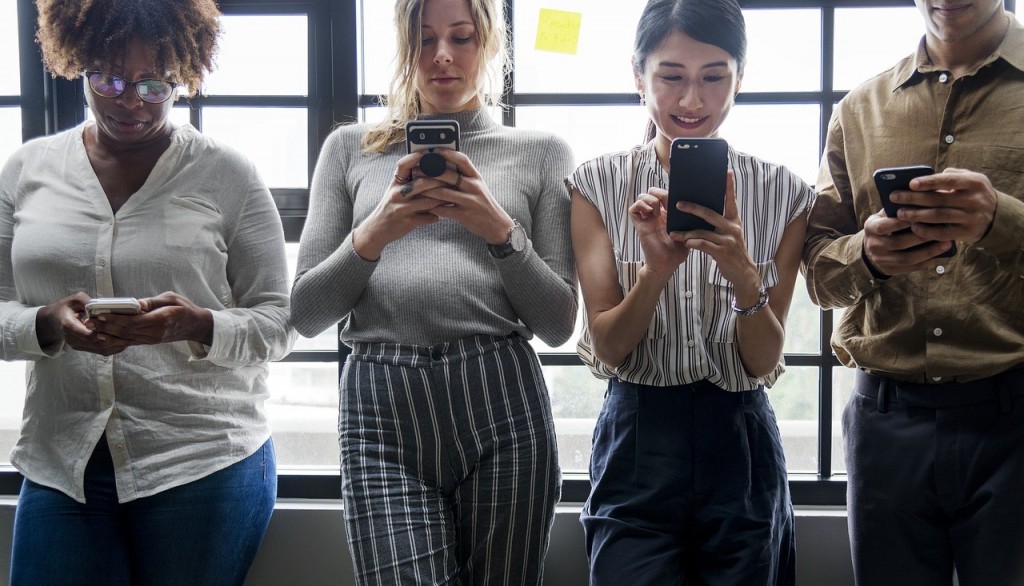 deliberately make at some point, and then stop thinking about, but continue doing, often every day.” And how habits are loops made up of three parts: the cue (or trigger), the response, and the reward. In the case of the phone, it could be me bored while waiting in line somewhere (cue or trigger) so I check my phone (response), and find that I have email I could read (reward). And so it goes. First in situations of boredom, then in times of avoidance (say, when I don’t want to hear my kids complaining), and finally, just because. How many times have you looked at your phone simply because someone else did? Or checked your email or texts, thinking you heard that little ding, but it was just your imagination. (If you can believe it, the term for that is phantom ringing syndrome.)
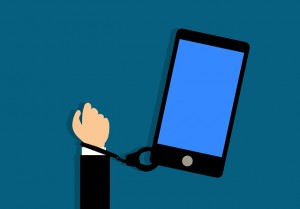 “No problem,” but then I seem to think of reasons why I might need it on (my mom for instance, or some excuse I think is “important”). In the end, it’s just silly anxiety running the show and making me think that the world will end in those twenty-four hours simply because I (the all-important legend in my own mind) don’t have my phone on (in reality, I guess, it is the phone running my show). I will post a follow-up when I complete my thirty days of phone withdrawal and let you know how it went!
 -line, there is a price to pay for being able to see anyone you know on the Internet – our privacy. Our kids today have been born into a time in which pictures are constantly taken then uploaded for the world to see. In turn, they will do the same, and it’s not always the super cute pictures of them as babies with a sleeping kitten, they’re pictures that can be humiliating or shameful – pictures they wouldn’t want anyone seeing, and now almost anyone can. Wiseman points out, “When you were a teen, your most embarrassing and humiliating moments weren’t up for public discussion and entertainment….She’s living that moment in public. There’s no protection. There’s no privacy. This is her regular, ever-present reality. Your daughter is growing up with a different definition of what’s public and what’s private.”
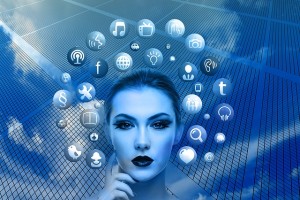 l when you were a kid and need that toy (I’m thinking Barbie again or He-Man in my brother’s case). This isn’t new either. But kids who play on-line, get free apps, or just use mom’s phone while in line at the grocery store, see double that, usually for other games (my eight-year-old son thinks he wants every game he sees advertised in other games). According to APA.org, “advertisers spend more than $12 billion per year to reach the youth market and that children view more than 40,000 commercials each year.” Think about all those opportunities for “I gotta have that,” “I need that,” “I’m not good enough or cool enough unless I get that.” It’s overwhelming! Again, if your tween is going to be a “normal” kid (and yes, he or she probably really wants to be) then an on-line world is inevitable – thus, so are the ads.
 e to know and what to do in a shooter situation is becoming more real and more of a possibility.
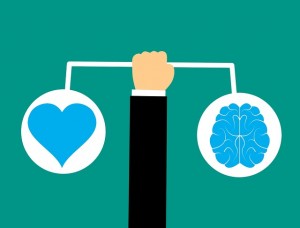 need a balance.